There is a particular silence in the workshop when a new slab of oak arrives. Not an empty silence, but a full one. It’s the quiet of listening. You run your hand along the surface, reading the story written in the grain. The wide, sweeping arcs that speak of a slow-growing Highland tree, standing for a century in a glen we know by name. The tight, frantic knots where a branch once fought for light. This is the first conversation we have with any piece, and it never lies.
But the oak for the Nebula Coffee Table arrived with a second story already etched into its skin. It was a reclaimed whisky barrel lid, and its history was held in a different kind of grain. The deep, rich hues and the ghostly rings of liquid that had soaked into the wood for years in a distillery warehouse. You could still smell it if you closed your eyes, a faint, sweet echo of peat and barley, a memory of fermentation and patience. This wood had lived a full life before it ever reached our bench. It had held a promise, a spirit, and now it was being asked to hold a new purpose.
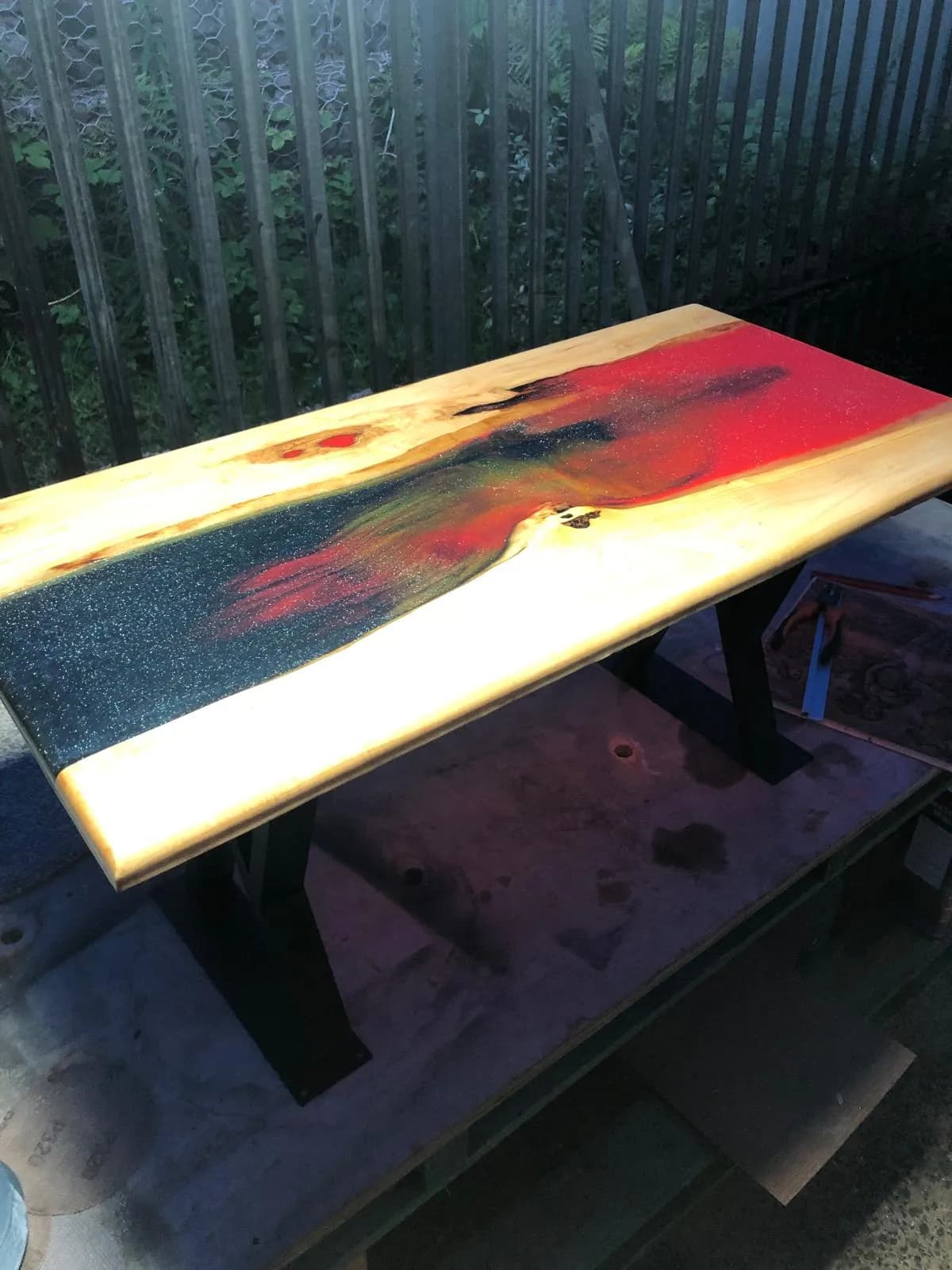
The transformation is a gentle persuasion, not a command. We begin by cleaning the barrel stave, revealing the character that the whisky’s journey had intensified. The natural cracks and checks in the oak, weathered by decades of temperature shifts in the warehouse, are not flaws to us. They are the very soul of the piece. We clean them out, meticulously, and then we introduce our element. The deep, black resin we use is like a captured piece of the night sky. It flows into those fissures, filling the history of the wood with a new, liquid darkness that hardens into a smooth, glass-like plane. It doesn’t cover the wood; it highlights it. The contrast between the warm, honeyed oak and the void-like resin is stark and beautiful. For the Nebula table, this resin work is the star. It pools in the cracks like ink on water, creating a map of constellations across the surface. The name comes from that, looking at the finished top is like gazing into a deep, woody galaxy.
From there, it is a process of joining and shaping. The barrel lid, curved from its former life, is carefully flattened and planed, but we leave the live edge where possible, that beautiful, wavy boundary between the finished top and the raw bark side. It’s a reminder of the tree it once was. The legs are crafted from matching solid oak, their own grain patterns a quieter echo of the tabletop’s drama. Every joint is cut by hand, every surface sanded from a coarse grit down to a silkiness you can feel with your bare palm. The final step is the oil. A food-safe, hard-wearing oil that sinks into the oak, protecting it while deepening its natural colour. It doesn’t sit on top; it becomes part of the wood. The resin remains cool and smooth, a permanent pool of darkness against the warm, tactile wood.
When it’s finished, it’s not just a table. It’s a collaboration across time. The tree that grew in a Scottish forest, the distillery that filled the barrel, the cooper who made it, and the hands that now work with it, we are all in that piece. The Nebula Coffee Table sits in someone’s home, holding cups of tea, books, the occasional remote control. It gathers the marks of a new life. A ring from a wet glass, a faint scratch from a key. And those new stories settle into the old ones. The whisky’s memory in the wood, the resin’s inky rivers, the new life lived on its surface. That is the craft. Not making something new from nothing, but listening to what already is, and helping it tell its next chapter.


Join the Conversation
Be the first to leave a comment on this entry.